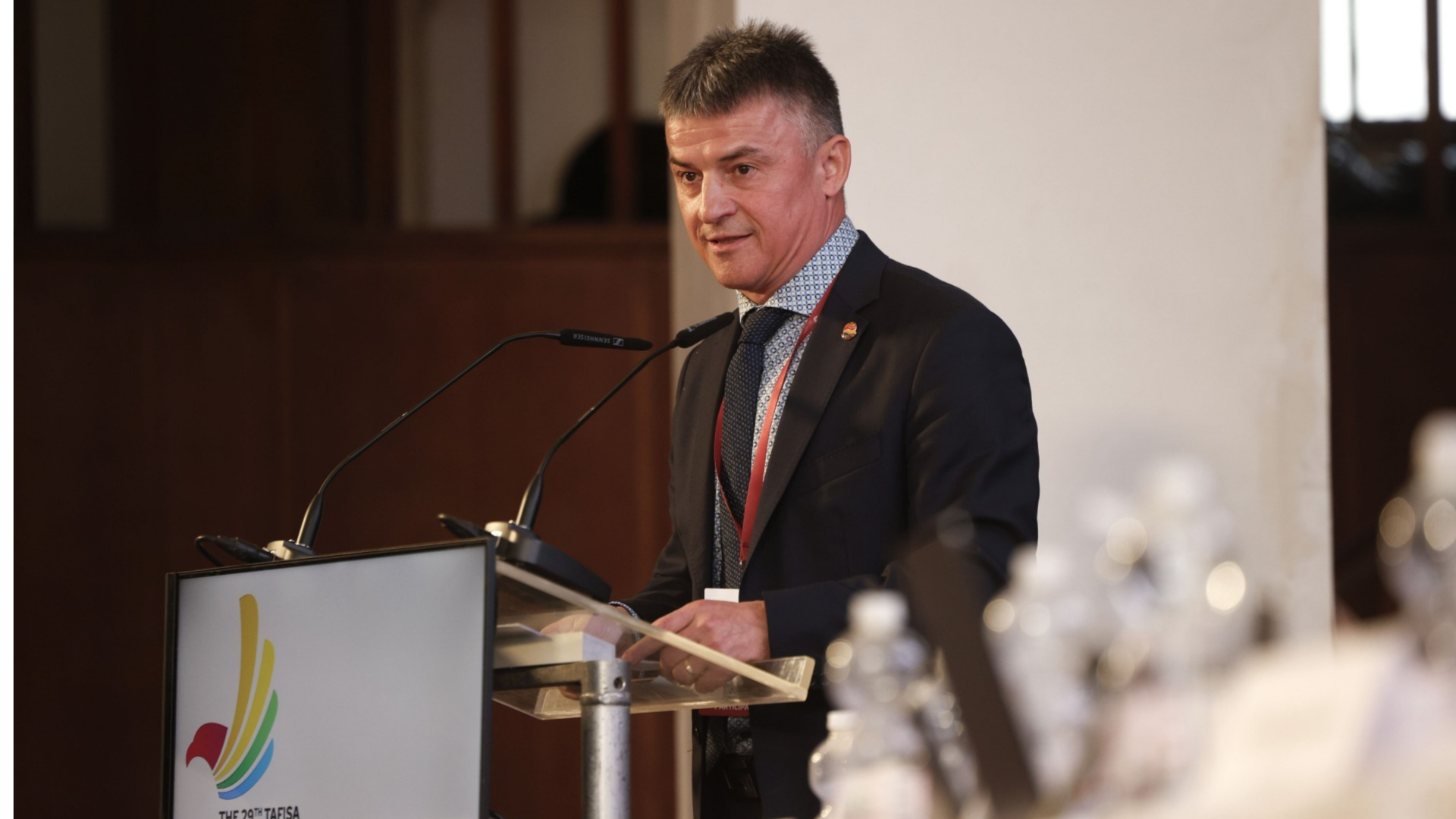
Following his recent election during the General Assembly of 16 May 2026 in Prague, Czechia, TAFISA President Janez Sodržnik shares his vision for the future of TAFISA.
First and foremost, congratulations on your election as new TAFISA President. What does it mean to you to be elected in this position?
For me personally, this is not just another professional step or organisational responsibility. It is a truly important life moment. Sport has shaped my life for decades - as an athlete, as a volunteer, as a leader, and above all as someone who strongly believes that sport can change lives, strengthen communities and make society better. I am both proud and humbled to have been elected into this position, alongside a very diverse and competent new Board of Directors with whom I am confident we can further the growth of the organisation.
As you embark on a 3-year journey at the helm of the organisation, what is your overall vision for TAFISA's future and its role in society?
In one sentence, I would say my vision is a strong, credible, and financially stable TAFISA that empowers its members, connects global partners, and leads the Sport for All movement worldwide.
We live in a world facing growing physical inactivity, social isolation, mental health challenges, ageing populations, inequality, and division. In such times, I strongly believe that Sport for All is not a luxury but a necessity.
TAFISA has shown that sport can promote health, inclusion, education, peace, social cohesion and happiness. Through programmes, education, research, events, and partnerships, TAFISA continues to empower communities and organisations across all continents to lead the global Sport for All movement.
Leading the global Sport for All movement is part of TAFISA's vision and identity. What will it take to continue achieving that goal?
Strengthening TAFISA's role as the leading global Sport for All organisation means that we must continue increasing our visibility, influence, and relevance internationally. TAFISA should be recognised not only within the sport sector, but also as an important partner in addressing wider societal challenges - health, social cohesion, education, inclusion, sustainability, and wellbeing.
With our unique position and network, we have a key role to play in building bridges between sport, governments, academia, international institutions and civil society. This is further emphasised by our successful strategic partnerships with international and intergovernmental institutions such as IOC, UNESCO, WHO, EU, Council of Europe, African Union Sports Council, among others. Because we are open and inclusive by design, we can continue our efforts to connect with various networks, cities, the private sector, social sector, health sector, and other relevant stakeholders working towards a better world. Whenever we join these conversations or platforms, we have the privilege but also responsibility to represent the Sport for All movement and its members, advocating for them and ensuring their voice is heard.
Let's talk about the members of the Sport for All movement indeed: how are TAFISA members involved in TAFISA's future development?
Members are the true heart and strength of TAFISA. We must continue listening to our members, supporting them more strongly, increasing opportunities for cooperation, and ensuring that membership in TAFISA brings real value - through knowledge, projects, visibility, advocacy, networking and mutual support. This is our role, enhancing the impact they can have on their communities, and enhancing our global impact as an organisation.
At the same time, we should continue expanding our membership geographically and structurally, while respecting the diversity and realities of different regions of the world. This might also mean meeting our members and their communities where they are and potentially developing regional hubs where members facing similar local priorities and realities can connect and work together.
Impact is a word that has become very important in recent years. How do you see TAFISA's impact on society in the future?
I think it's important to focus on the further development of impactful programmes and initiatives. Physical inactivity, sedentary lifestyles, mental health challenges, youth disengagement, and ageing societies are global issues affecting a lot of countries and regions, and they are currently worsening. TAFISA has the knowledge, the network, and the credibility to help respond to these challenges through Sport for All. We must continue developing innovative programmes, strengthening education and capacity building, and ensuring that our activities create measurable and long-term impact in communities around the world. This also means that we must increase our efforts for monitoring and evaluation across all our initiatives to maintain the highest standard of quality for positive impact.
TAFISA is often recognised not only for its initiatives but also its network – how does this come into play?
Our role is also to share the word and tell compelling stories demonstrating the power of Sport for All to change the world. As a hub for the Sport for All movement, our high-profile events benefit from an established international recognition by practitioners and decision-makers alike. Whether it's through the TAFISA World Congress where we tackle issues of policy, practice, innovation, the World Sport for All Games where we celebrate participation, inclusion, and cultural exchange, or other international and regional events, these gatherings are essential to advocate for the relevance of Sport for All. They are places where ideas, cultures, innovation and friendships come together to generate more impact. We must continue modernising and strengthening these events so they remain attractive, relevant and impactful for both practitioners and decision-makers.
Looking inwards at the organisation itself, what will be your priority for TAFISA internally?
The first priority would be financial sustainability and organisational stability. Strong organisations require strong and stable foundations. Without this prerequisite, none of the strategy and vision I mentioned before would be possible.
In the coming years, with the newly elected TAFISA Board of Directors and the TAFISA Secretariat we must continue diversifying our funding sources, strengthening strategic partnerships and ensuring transparent, responsible and efficient governance. Stability is not only about finances - it is also about trust, professionalism and long-term credibility.
Thank you for this interview. As a last word, how would you want the world to see your TAFISA?
I hope that organisations and people can recognise TAFISA to be much more than an organisation. It is a global community built on trust, shared values, friendship and long-term commitment. And the more partners and friends with common goals join us, the more we will be able to achieve together.