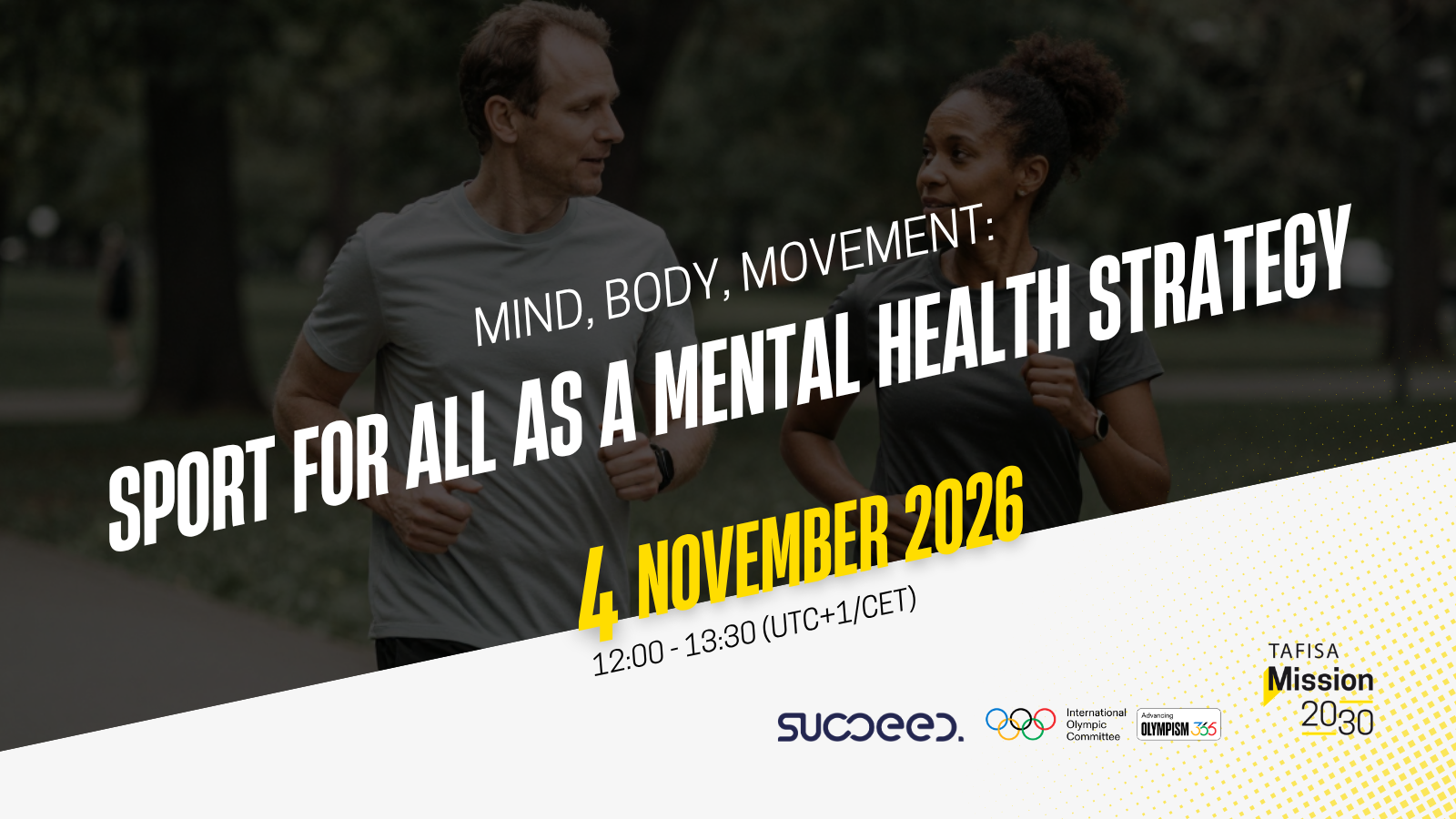
We are pleased to invite you to our next webinar on the topic, "
Mind, Body, Movement: Sport for All as a Mental Health Strategy". The webinar will be hosted on 4 November from 12:00 to 13:30 (UTC+1/CET).
Save the date and register now to secure your spot!
In recent years, mental health has moved from the margins of public conversation to the centre of it, but there is still a lot to be done. Roughly one in eight people worldwide live with a mental health disorder, and depression and anxiety are the most common types of mental health disorders among both men and women. Services remain stretched, unevenly distributed and, in many countries, out of reach for the people who need them most, with still so much stigma around the topic. Against this backdrop, the places where people already gather- the pitch, the park, the community hall, the training field- take on a significance that goes well beyond recreation.
Sport environments can also damage mental health through performance pressure, appearance-focused coaching language, exclusion, bullying, or the absence of anyone equipped to notice when a participant is struggling. The same session can be protective or harmful depending on how it is led. This places coaches, volunteers and programme designers at the centre of any serious mental health strategy.
The World Mental Health Day 2026 theme, "Lived Experiences Heard: Real Voices, Real Change", speaks directly to this. It asks institutions to stop designing on behalf of people and start designing with them, treating people with lived experience as a source of expertise rather than as a category of beneficiaries. For Sport for All, that means asking participants, including young people, women and girls, people with disabilities, migrants, older adults and those living with mental health conditions, what actually makes a sport space feel safe, and then changing practice accordingly.
This webinar explores what it takes to treat Sport for All as a deliberate mental health strategy rather than an incidental one. Drawing on practitioner experience and case studies, it will examine how well-being objectives are written into programme design from the start; what coaches can reasonably be asked to do, and where the line sits between supporting a participant and referring them onward; how organisations build working relationships with mental health services instead of operating in isolation; and how participants' own voices are brought into design and evaluation in a way that leads decisions rather than validating them.
The 90-minute program will bring together experts, lived experiences and professionals. It aims to enlighten, encourage action, and share best practices.
Don't miss out! Register and share this with your network, work colleagues, and friends! Participation is
FREE and open to everyone. Register here:
https://us06web.zoom.us/webinar/register/4817612346636/WN_dbq9T-5OSKG_sMt8I8VhegFollowing your registration, you will receive a link to join the Webinar on Zoom.