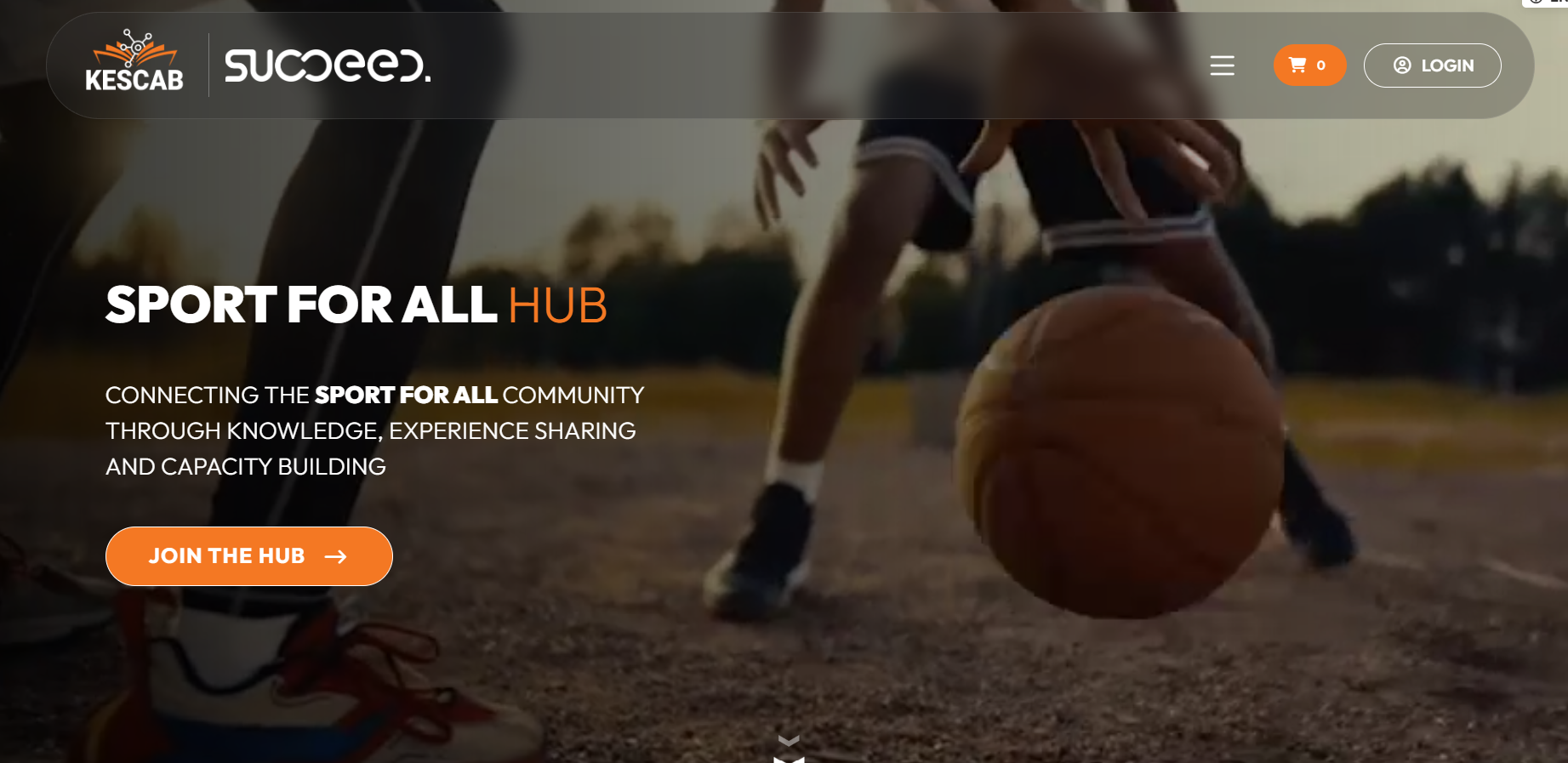
The KESCAB Online Hub was launched in May 2026 as a digital capacity-building platform for the global Sport for All sector. It was created to support learning, collaboration, and knowledge exchange within the global Sport for All sector.
Developed as part of the Knowledge, Experience Sharing and Capacity Building (KESCAB) project, an Erasmus+ initiative funded by the European Union, the hub seeks to strengthen organisations working in Sport for All by providing accessible opportunities for education, networking, and cooperation across sectors and borders.
The project is led by TAFISA together with a consortium of partners, including the International Council of Sport Science and Physical Education (ICSSPE), Sports Union of Slovenia (SUS), España se Mueve (EsM), the French National Olympic and Sports Committee (CNOSF), Laureus Sport for Good Foundation, the Knowledge Centre for Sport and Physical Activity Netherlands (KCSB), and the Portuguese Sports Confederation (CDP).
Six months on, the Hub is no longer a launch announcement. Trainer cohorts are delivering courses in Spanish, Portuguese, English and French as part of the pilot process. A large network is being built and continuously growing on the platform. Community discussion groups are open. And new self-paced modules are about to be released.
What the Hub offers
Courses in multiple languages. The Hub delivers self-paced modules and trainer-led courses in multiple languages. Trainer-led cohorts have already run in French, Spanish and Portuguese, each built around live sessions with discussion continuing between them.
Webinars and events. Sessions are hosted on the platform with registration, recordings and supporting materials in one place. Rather than disappearing once the hour ends, each session leaves behind a record that members can return to.
A network of trainers and alumni. Everyone who completes a capacity building programme joins a network, grouped by cohort. Learners can see who trained them and who trained alongside them.
A resource library. Research papers, policy documents, practical guidebooks and recordings of past webinars, collected in one place and tagged so they can be found by subject.
Open registration. Anyone can create an account at sportforallhub.com free of charge. There is no gatekeeping and no fee.
Community discussions
The discussion groups are what distinguish the Hub from a course catalogue.
Every course and cohort has a space where members share experience, ask questions and work through problems together.
For learners, the value lies in the fact that a course does not end after the final session. Discussions with the trainer continue after the final session. Materials and tasks can be submitted for review and feedback. Learners can vote on the topics covered in upcoming sessions and webinars, so what comes next reflects what the community actually wants.
For the wider movement, the value is that experience-sharing opportunities are unlimited. Good practice developed by one becomes visible to other practitioners, and the people who have done the work become reachable to the people about to attempt it.
This is the part of the Hub that grows with use. Each cohort that completes a course adds to the pool of experience available to everyone already there.
What's coming next
New self-paced modules
In the coming weeks, the Hub will release online modules in multiple languages, developed through the KESCAB project and free to Hub members. Each is self-paced, so members work through them around their own commitments rather than to a fixed schedule.
| Module | What it covers |
|---|
| Community Management and
Engagement in Sport for All | How to build and sustain participation, and how to engage communities as partners rather than audiences |
| Good Governance | The structures, accountability and decision-making that keep Sport for All organisations credible and sustainable |
| New Spaces for Sport and Physical Activity in Sport for All | How to open up and adapt spaces so that physical activity reaches people where they already are |
Each module pairs with a discussion group, so members working through the same material can compare how it applies in their own contexts.
A Physical Literacy course
A Physical Literacy course is also coming to the Hub, alongside more courses from partner organisations. The aim is for the Hub to serve as a starting point for capacity building across the sector, not only for programmes TAFISA runs itself.
More to follow
More courses, webinars and resources will be added. Hub users will see new material as it arrives.
Ways to get involved
The Hub is built to be contributed to. There are several ways to take part.
Learn and grow your skills. Access courses, webinars and training programmes designed to support capacity building and professional development across the Sport for All sector.
Share your knowledge and expertise. Contribute resources, share insights and show the wider community what your organisation has learned.
Host and deliver learning content. Organisations and experts can use the platform to run their own courses, webinars and educational sessions, reaching an audience already gathered around Sport for All.
Build networks and collaborate. Connect with individuals and organisations worldwide, form partnerships, and help shape how the Hub develops.
Promote the Hub. Share the platform within your own networks, so that access to learning and collaboration reaches further.
Give feedback. Tell us what works and what does not. The Hub improves through the suggestions of the people using it.
How to join
Registration is open to anyone at sportforallhub.com and is free of charge. Once registered, you can browse courses, join discussion groups, view the network of trainers and trainers of trainers, and sign up for upcoming sessions.
About the KESCAB project
The KESCAB Online Hub was developed through the Knowledge, Experience Sharing and Capacity Building project, an Erasmus+ initiative funded by the European Union. Its purpose is to strengthen organisations working in Sport for All by making education, networking and cooperation accessible across sectors and borders.
The project is led by TAFISA, together with a consortium of partners: the International Council of Sport Science and Physical Education (ICSSPE), the Sports Union of Slovenia (SUS), España se Mueve (EsM), the French National Olympic and Sports Committee (CNOSF), the Laureus Sport for Good Foundation, the Knowledge Centre for Sport and Physical Activity Netherlands (KCSB) and the Portuguese Sports Confederation (CDP).
Funded by the European Union. Views and opinions expressed are however, those of the author(s) only and do not necessarily reflect those of the European Union or the European Education and Culture Executive Agency (EACEA). Neither the European Union nor EACEA can be held responsible for them.